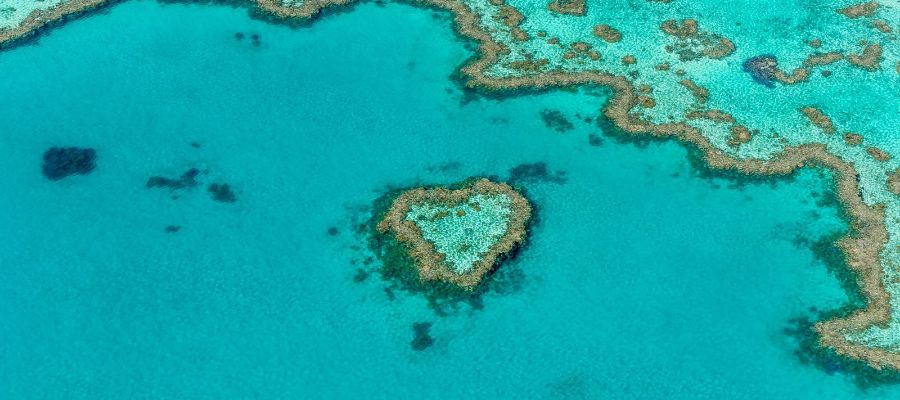
There are some places that are instantly recognisable from a photograph, and Heart Reef is one of them.
Sitting among the turquoise waters of the Great Barrier Reef, this naturally formed heart-shaped coral reef has become one of the most photographed sights in the Whitsundays. It’s small compared with the vast reef system surrounding it, but from the air its almost perfectly defined outline makes it difficult to miss.
If Heart Reef is on your Whitsundays itinerary, here’s what to know about where it is, how it formed and, most importantly, how you can see it for yourself.
What is the Heart Reef?
Heart Reef is a naturally formed coral formation shaped remarkably like a heart.
Rather than being an island or a sand cay, it is a coral bommie — an isolated reef formation rising from the surrounding seabed. Heart Reef measures roughly 17 metres across and forms part of the Great Barrier Reef in the Whitsundays.
Its distinctive shape is entirely natural, which is part of what has made it such a recognisable symbol of the region.
And while photographs of Heart Reef can make it look quite large, its scale becomes much clearer when you see it in the context of the surrounding reef. From above, the small heart sits among a much larger patchwork of coral, lagoons and deeper blue water.
Where is Heart Reef?
Heart Reef is located in the Whitsundays region of the Great Barrier Reef, approximately 60 kilometres northeast of Hamilton Island. It sits within the Hardy Reef area, beyond the Whitsunday Islands themselves.
That distinction is useful if you’re planning a trip. Hamilton Island, Whitehaven Beach and Heart Reef are all commonly associated with the Whitsundays, but they aren’t sitting side by side.
Hamilton Island is one of the region’s inhabited islands. Whitehaven Beach sits on Whitsunday Island, while Heart Reef is farther offshore within the Great Barrier Reef.
It’s one of the reasons seeing the region from the air is so different from travelling through it by boat: the flight reveals how the islands, channels, beaches and outer reef all connect.
Is Heart Reef really naturally heart-shaped?
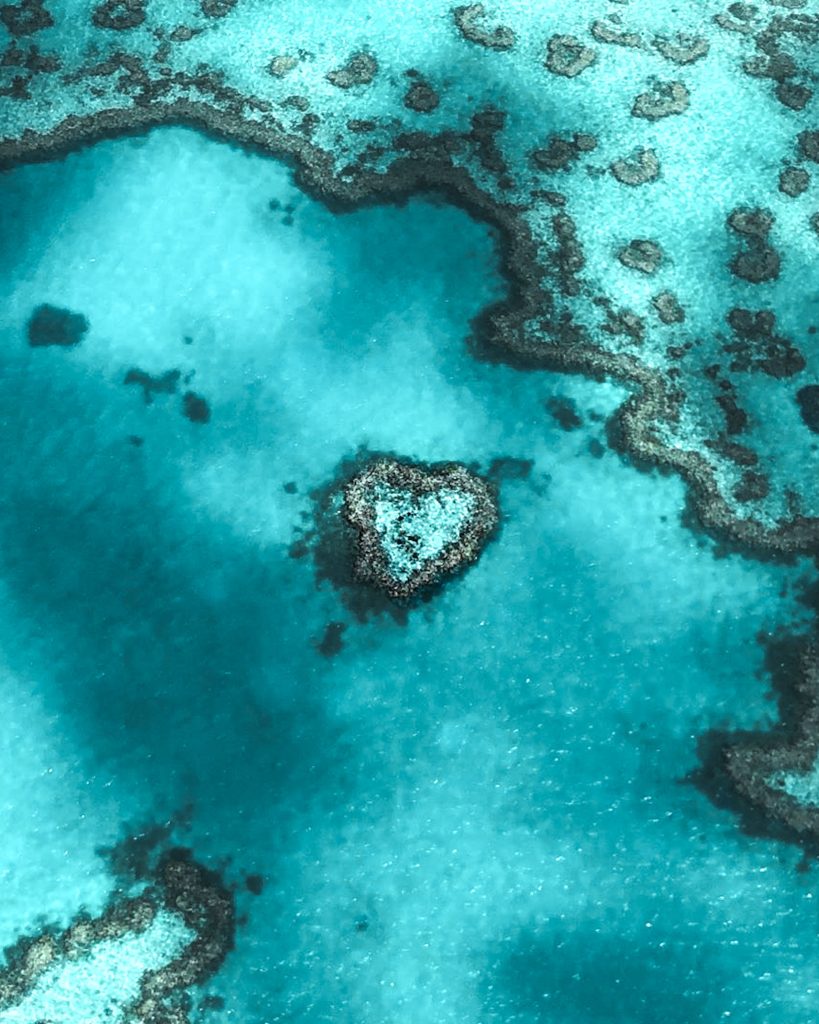
Yes. There has been no landscaping involved in creating its distinctive outline. Heart Reef developed naturally into the shape visible today.
It is particularly striking from above because of the contrast between the coral and the clear blue water around it. What might look like a relatively unassuming patch of reef at water level becomes unmistakable once you gain altitude.
That aerial perspective is also the reason most of the familiar images of Heart Reef in the Whitsundays have been photographed from helicopters, aeroplanes or seaplanes.
Why is Heart Reef so famous?
Its shape certainly helps. Heart Reef has become one of the Whitsundays’ most recognised landmarks and an enduring image of the Great Barrier Reef. Tourism Queensland describes it as one of Australia’s most recognised natural attractions, while the surrounding Whitsundays are among the most visited regions of the Great Barrier Reef.
But there is another reason the view is so memorable. The Great Barrier Reef is enormous. The Marine Park covers around 344,400 square kilometres and contains roughly 3,000 individual coral reefs. Heart Reef represents only a tiny part of that ecosystem.
Seeing it from the air puts that scale into perspective. Beyond the familiar heart shape are vast stretches of reef shelf, channels and coral formations that continue towards the horizon.
Can you visit Heart Reef?
You can visit the Heart Reef area, but there is an important distinction: Heart Reef itself is protected, so visitors don’t simply arrive by boat and snorkel directly over the heart-shaped coral formation.
Traditionally, the classic way to experience it has been from the air.
Today, visitors staying on Hamilton Island can also get closer through Hamilton Island Air’s Journey to the Heart experience. The helicopter journey lands at Heart Island, a private pontoon moored within Heart Reef Lagoon. From there, guests can take a glass-bottom boat around Heart Reef and snorkel within an adjacent lagoon rather than on Heart Reef itself.
This allows the reef to be seen from both perspectives: first as that unmistakable heart from above, then at water level where its scale and surrounding marine environment become much more apparent.
What is the best way to see Heart Reef?
For the classic view, from the air. The heart shape is most obvious when you’re looking almost directly down at the reef, which makes scenic flights particularly well suited to seeing it.
There are a few different ways to approach the experience depending on how much time you have.
See Heart Reef on a scenic flight
If you mainly want the aerial perspective, a non-stop scenic flight allows you to see Heart Reef as part of the wider Whitsundays landscape.
Hamilton Island Air’s scenic routes can also pass landmarks including Whitehaven Beach, Hill Inlet and sections of the Whitsunday Islands and Great Barrier Reef, meaning Heart Reef becomes one part of a much broader view of the region.
This is a particularly good option if you have a busy Hamilton Island itinerary but still want to see the outer reef.
Experience Heart Reef from the air and water
For a closer look, Journey to the Heart combines the scenic helicopter flight with time at the Heart Island pontoon.
The journey flies across the Whitsundays and Great Barrier Reef before landing in Heart Reef Lagoon. From there, a glass-bottom boat provides a closer perspective of Heart Reef, while snorkelling takes place in an adjacent lagoon.
Discover Journey to the Heart →
What else can you see on the way to Heart Reef?
One of the advantages of flying to Heart Reef from Hamilton Island is that the journey itself covers some of the Whitsundays’ best-known scenery.
Depending on the flight and operating conditions, views can include:
- Whitehaven Beach, stretching along the eastern side of Whitsunday Island
- Hill Inlet, where shifting tides create swirling patterns through white sand and blue water
- Whitsunday Island, the largest island in the group
- Hook Island and Hook Reef
- Channels and passages between the Whitsunday Islands
- The wider Great Barrier Reef
Hamilton Island Air’s Journey to the Heart route includes aerial views over Whitehaven Beach, Hill Inlet, Whitsunday Island, Hook Island and Heart Reef.
It makes the experience less about flying to a single landmark and more about seeing the geography of the Whitsundays unfold beneath you.
When is the best time to see Heart Reef?
Heart Reef can be experienced throughout the year, although conditions over the Whitsundays naturally change with the seasons.
The region’s drier months, generally from May to October, tend to bring lower humidity and plenty of clear days, while the warmer months from November to April are hotter and more humid.
For scenic flights, however, the more important factor on any particular day is the weather and visibility. Flight operations are always subject to conditions, and some Heart Reef experiences are also tide-dependent. Hamilton Island Air currently operates Journey to the Heart with departures subject to suitable tides.
Rather than planning a trip around a single “perfect” month, it can be worth allowing some flexibility in your Hamilton Island itinerary.
Is Heart Reef part of the Great Barrier Reef?
Yes. Heart Reef is part of the Great Barrier Reef, within its Whitsundays region.
The Great Barrier Reef extends for more than 2,000 kilometres along Queensland’s coastline, so destinations within it can be surprisingly far apart. The Whitsundays occupy one section of this much larger marine environment.
Heart Reef is one of the region’s most recognisable individual coral formations, but it is surrounded by a much larger reef system, something that becomes particularly obvious from the air.
Seeing Heart Reef from Hamilton Island
For many visitors, Heart Reef is one of those places they have seen in photographs long before arriving in the Whitsundays.
Seeing it in person is quite different. From the air, the familiar heart is suddenly surrounded by kilometres of reef and open ocean. Whitehaven Beach and the Whitsunday Islands sit behind you, the outer Great Barrier Reef stretches ahead, and the scale of the region becomes much easier to understand.
If you’re staying on Hamilton Island and want to experience the reef beyond the classic aerial view, Journey to the Heart takes you from Hamilton Island across the Whitsundays before landing at Heart Island in the lagoon.